

It was a month of March in Gwalior when I was planning for my first Jharkhand trip. So, I called up my friend in New Delhi asked him for some suggestions. He said if you are going to Jharkhand, Do not miss Amadubi, one of the most famous rural tourism sites of Jharkhand and known for Paitkar paintings. Because, exploring villages and their culture is always on my wish list So, I added Amadubi in my itinerary.
Jharkhand
It is the 28th state of India, which came into existence in November 2000, is the homeland of more than 18 tribal communities. It largely comprises forest tracks of Chhota Nagpur plateau and Santhal Pargana and has distinct cultural traditions. With nearly one-third of its total area under forest cover, Jharkhand is rightfully called the ‘Land of forests’ and is bounded by West Bengal in the east, Uttar Pradesh and Chhattisgarh in the west, Bihar in the north and Odisha in the south.
So I took a flight from New Delhi and reached Ranchi, the capital city of Jharkhand. These days air connectivity is very good between Ranchi and other major cities of India. After completed my 2 days official work in Ranchi city, I called Mr. Amitava Ghosh, the man behind Amadubi Village and Kalamandir. He happily invited me to his place that is Jamshedpur and assigned one local artist Mr. Vijay Chitrakar for guiding me. He is one of the prominent artists of Paitkar painting.
I met Vijay in one exhibition in Ranchi, and then we both took a bus to Jamshedpur. Government AC (Drutgami) Bus facilities between Ranchi and Tata (another name of Jamshedpur) is very good. In next 4 Hours, We reached Jamshedpur and directly headed to Amitava Dada’s place named Biponi, Kala-Mandir. Stayed at Dada’s place, because morning 4:00 am, we have to take the local train to Dalbhumgarh from Tata Nagar (Railway station of Jamshedpur).

After 50 min. the train journey, we reached Dalbhumgarh where Vijay Dada arranged an auto-rickshaw that took us to Amadubi village. I have observed that Local people were talking in Bengali language and most of the information written in Bengali script. Vijay dada told me that this village is located very near to West Bengal Border and Odisha border is also not too far. So these places are influenced by Bengali culture and its language.


A road to Amadubi
It was in very good condition and seems that ‘Pradhan Mantri Gram Sadak Yojna’ has done a great work in the region. It was the morning time, so the local people were about to go on their works like to go on their farms/ fields, to go to the market to sell their products, to go with cattle etc. Local traditional homes were unique and clean. Most of the home had trees and cows in their premises. We reached Amadubi-Panijiya at 5:30 am.


Amadubi or ‘The Art Village’
65 km south of Jamshedpur, offers a unique opportunity to those interested in learning more about the indigenous tribes and their customs. The village provides the perfect backdrop for presenting tribal life in all its variety. It is the place known for Paitkar painters and you can see live Demo of the art. Tribal people perform folk dance here.
Sunrise in Amadubi

The moment, we reached Kala Mandir, loud music sound was coming from one direction. Vijay Dada, my friend cum guide and the local resident told me that today is Ram-Navami, (one of the important festivals in India) and local peoples are celebrating it in their traditional form. Without taking rest, I requested Vijay Dada to take me to that religious place and a short tour of his village. First, we headed towards the festive place. It was a small and beautiful temple of the village, where local folk artists were singing and praising their god.

Then, we went on a village tour. This place consists of two adjacent villages Panijiya and Amadubi. Tourist can be covered both villages in one round.
Traditional Houses in Amadubi


Village Art of Jharkhand


Bullock Cart

Amadubi Village Life


Cattle life in Panijia

Amadubi School:

Religious place of Tribal community

Government Schemes

Dry Forest Area of Amadubi


Traditional Construction at Amadubi

Grocery shop at Amadubi

Then we stopped at Vijay Dada’s home. His family welcomed me and showed some of his paintings that are of Paitkar art.
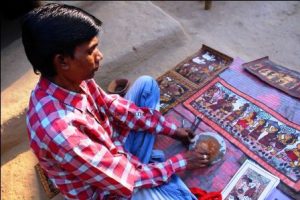
Paitkar Art Form
Pata Chitra is a traditional form practiced by the Paitkar community. Living in Jharkhand, West Bengal, and Odisha, Paitkar is a small community and is both socially and economically marginalized in this region. Traditionally, the Paitkar would earn a living as storytellers, making use of Pata Chitra to tell their stories. Pata Chitra was traditionally made on scrolls of paper. Natural dyes made from fruits, bark, flowers, soil, stones, and leaves were used to color the painting giving the scroll a rich, earthy feel. Popular stories depicted in the Pta Chitra paintings included; Stories of Krishna Leela, Ramayana, Mahabharat, Santhal Utpatti, etc.


Finally, we reached Amadubi Rural Tourism Centre; another name is ‘Rushika Sangiko’ literally means ‘Kala Gram’ or ‘Artist’s place’.

Amadubi Rural Tourism Centre
It was started by State Tourism Ministry in 2013 with the help of NGOs to promote Amadubi- Panijiya as the rural tourism destination and give employment to the local artists. Tourists from all over the world visit this place.

They provide facilities like accommodation, dining, museum, amphitheater, garden, library, water recharge system etc.
Museum at Amadubi Rural Tourism Centre


Cottages and Dormitory
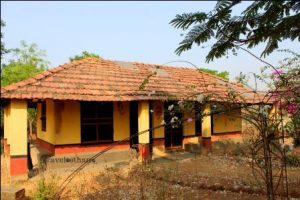


Have had a tea and breakfast, and talk to local people about their culture and lifestyle.

Now time to say bye to the village. It was a wonderful journey to the village or to a nursery of Paitkar art. Local people were hospitable and my special thanks to Mr. Vijay who was always guiding me and help me understand the local culture. And I never forget the daughter of Vijay Dada.

How to Reach Amadubi
- Airways: Nearest Airport is Birsa Munda Airport, Ranchi (170km). Ranchi is connected to New Delhi, Kolkata, Mumbai, Bangalore, Hyderabad etc on regular basis.
- Railways: Nearest Railway Station is Dhalbhumgarh (7km) located on Mumbai- Howrah line. For Express trains, Ghatsila (20km) and Chakulia (25km) are good options.
- Roadways: Dhalbhumgarh (7km) is the nearest Bus Stop for regular buses. Local buses to neighboring states like West Bengal, Bihar, and Odisha available on regular basis.
Where to Stay in Amadubi
Rural Tourism Centre is the best place to stay in Amadubi village.


Very well written.
Very Nicely written..If anyone reads the above information, even accidentally..They never miss the destination..
I’ll definitely visit …
thanks for the information.