
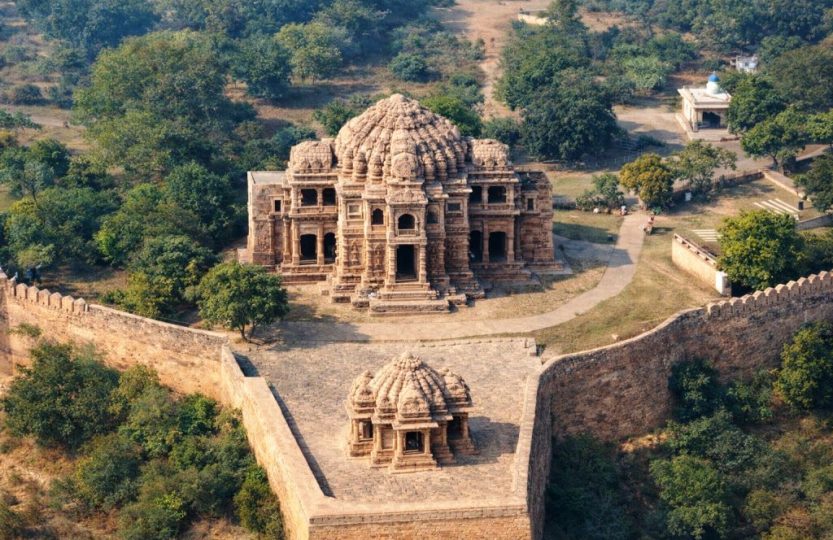
By a fortunate coincidence, I recently met a group of nature lovers, spiritual guides, artists, and history scholars at Gwalior Fort. They had come from different parts of India to explore its heritage. The task of introducing them to the fort’s history was entrusted to me. To assist in guiding them through the monuments, I invited my friend Dr. Ankit Agarwal. Together, we began a “Heritage Walk,” which included a visit to the Saas-Bahu Temple, also known as Padmanath Mandir.
During this heritage walk, visitors hailing from across India toured and explored the Man Mandir (Man Singh Palace), Karan Mandir, Shah Jahan Mahal and Tal, Jauhar Kund, Bhim Singh Chhatri, Rani Tal–Cheri Tal, Jayanti Thor, Assi Khamba Baoli, Hathiapor, Lakshmanapor, Chaturbhuj Temple, Ganeshapor, Badalgarh, Hindolapor, the Gujari Mahal Museum, Suraj Kund, Gangola Tal, Teli ka Mandir, Scindia School, the Gurudwara, and the Padmanath Temple, thereby learning the true history associated with these sites.
In this issue, we present to our discerning readers some fascinating information regarding the Padmanath Temple.
Saah-Bahu or Padmanath Temple?
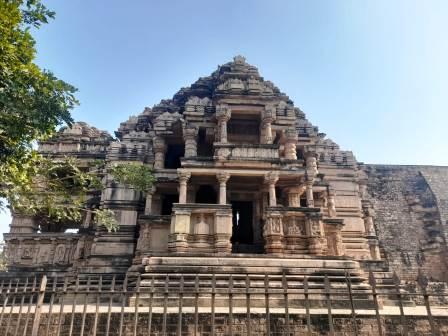
Perched on the eastern edge of Gwalior Fort, the Padmanath Temple—dedicated to Lord Vishnu—is popularly known as the “Saas-Bahu ka Mandir” due to its twin structures, one large and one small, resembling each other. Though the temple has endured invasions and vandalism, the inscriptions at its main entrance remain intact, offering authentic historical details and preserving its legacy despite centuries of destruction.
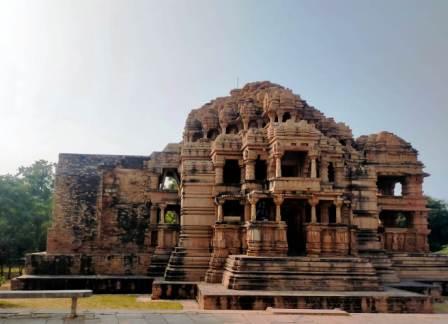
Historical facts about Padmanath Temple alias Saas-Bahu Temple
- Construction of this temple was initiated by Padmapala Kachhwaha, the ruler of the Gwalior Fort. Being a devout worshipper of Lord Vishnu, he commenced the inscription with the invocation ‘Om Padmanathaya’ to facilitate his daily remembrance of his cherished deity, Padmanatha. Furthermore, as the phrase ‘Shri Padmanatha Sura Mandiram’ is explicitly inscribed within the poetic text, there remains no room for doubt regarding the actual name of the temple.
- According to the inscription, neither the complete construction of the temple nor the Prana Pratishtha (consecration ceremony) of the sacred idol could be accomplished during the lifetime of Padmapala—the son of King Devapala of the Kachchhapaghata dynasty. Following King Padmapala’s demise, his successor (and cousin), King Mahipala of the Kachchhapaghata dynasty (son of Suryapala), fulfilled his predecessor’s vision in 1093 CE. King Mahipala had vowed to complete this temple at the time of his coronation—a pledge he successfully redeemed. Historical evidence bears witness to the fact that the fame of this temple extended across the entire length and breadth of India.
Why the Saas-Bahu Temple Captivates the Nation
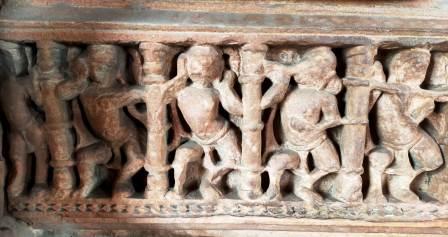
- Exquisite artistic motifs were intricately carved into the sandstone on every section of this temple (a subject that will be elaborated upon later in this article); consequently, the temple appeared far more magnificent when compared to other renowned temples of the era.
- The hill upon which the Gwalior Fort stands rises to a height of approximately 300 feet. Situated at such an elevation, this temple radiated a unique aura of splendor, serving as a focal point of reverence for all the citizens of Gwalior during that period.
- King Mahipala further adorned this temple with gold embellishments. The golden ornamentation adorning the stone-sculpted lion statue atop its spire presented this temple as ‘Kanakanchal’ (the Golden Peak).
- The idol of Lord Vishnu, enshrined within the sanctum sanctorum of the Padmanath Temple, was bedecked with an abundance of gold ornaments. Notable among these were a necklace of emeralds, a gold garland studded with various gems, a pair of armbands (keyuras) for the upper arms, and four gold bracelets inlaid with precious stones.
- Above the idol stood a golden parasol (chhatra) the staff of which was also crafted from gold. The temple’s spire was graced by a golden finial (kalash) and a golden flagpole.
- In addition to the aforementioned wealth, the temple employed distinguished dancers recruited from across India to serve in its precincts. Along with them, numerous instrumentalists, vocalists, and other artists also received royal patronage. From time to time, King Mahipala bestowed upon these dancers various gold ornaments as gifts and remuneration.
Revenue Management of Saas-Bahu Temple
To ensure the perpetual maintenance of the temple, King Mahipala established a system for a continuous flow of funds. A specific district of Gwalior—known at the time as the village of Pashanpalli—was entirely dedicated to the temple. This meant that all taxes (state levies) collected from that region were allocated exclusively to the temple. The area also housed a salt mine, the entire revenue from which was likewise assigned to the temple.
The revenue from the Pashanpalli region was divided into thirty equal shares. Out of these, five and a half shares were set aside for Naivedya, Aarti, and temple festivals. The remaining twenty-four and a half shares were used for the Brahmins and priests. They also supported the dancers who performed in the temple. Finally, these shares covered the general upkeep and maintenance of the temple complex.
Such was the glorious saga of the grandeur of this temple and of Gwalior. Thereafter, however, began the era of Islamic invasions and destruction.
When the Dark Shadow of Islam Fell Upon the Saas-Bahu Temple:
In the year 1200 C.E., the Islamic marauder Qutb-ud-din Aibak launched an invasion of Gwalior.
The outcome of this fierce battle favored the Islamic aggressor, Qutb-ud-din. He seized control of the fortress. All the wealth available there was plundered; the temples were desecrated, the idols of deities were torn down, and—specifically to wound Hindu sentiments—the gods were humiliated and destroyed.
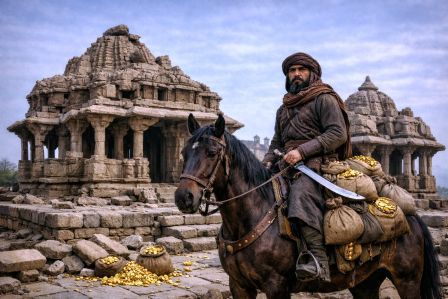
Needless to say, the dancers—who were as beautiful as celestial nymphs—were also treated as spoils of war. They were subjected to inhumane atrocities, and the marauders carried them away along with the other plunder.
Architecture of Padmanath Temple or Saas-Bahu Temple
Constructed from sandstone, this temple faces north. While the temple’s entrance is currently situated on the western side, originally (in its pristine form), the entrance was located on the northern side of the temple complex. Upon entering the premises, a pillar still stands tall to this day. It measures 27.5 feet in height and has a diameter of 2 feet at its base. This pillar serves as the temple’s Garudadhvaja (Garuda Standard); however, only the pillar itself remains today, as the statue of Garuda that once surmounted it has been destroyed.
The main temple structure is situated approximately 150 feet away from this flagstaff. It extends 100 feet from north to south, while its lateral dimensions—spanning from east to west—measure a total of 63 feet in width. Its base, known as the Vedibandha, stands 12 feet high. The temple is divided into three distinct levels; this stratification becomes evident when observing the rows of column-supported mandapas (halls). The upper half of the ground level features open windows (Vatayanas).
The Padmanath Temple is architecturally segmented into an Ardhamandapa (Entrance Hall), Madhyamandapa (Central Hall), Mahamandapa (Great Hall), Antarala (Vestibule), and Garbhagriha (Sanctum Sanctorum). The Mahamandapa spans an area of 30 feet.
Reconstruction of Saas Bahu Temple
The Padmanath Temple was originally constructed in the 11th century but faced destruction in 1200 at the hands of Qutb ud-Din Aibak. Centuries later, in 1881, it was rebuilt under the orders of Shrimant Jayajirao Scindia, with Major Keith of the Archaeological Survey overseeing the restoration.
Thanks to this monumental restoration effort, the temple today continues to captivate tourists with its inherent beauty.
Following its reconstruction and subsequent preservation, the temple now presents such a mesmerizing visage that visitors—both domestic and international—rarely miss the opportunity to capture its splendor through the lenses of their cameras. This is an excellent spot for photography enthusiasts.
We must acknowledge the vision of His Highness Shrimant Jayajirao Scindia Maharaj for reviving the temple. Gratitude is also due to Major Keith and the British officers who supported this restoration.
Saas Bahu Temple: An Excellent Spot for Photography
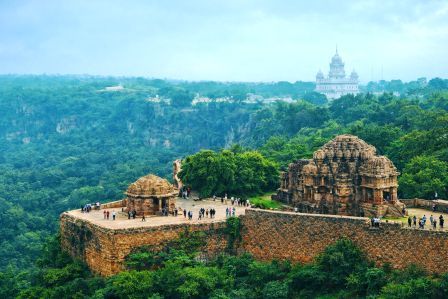
How to Reach Sassh Bahu or Padmanath Temple.
The temple stands atop the iconic Gwalior Fort in Madhya Pradesh. Visitors can reach it by entering through the Alamgir Gate and passing Hindolapor and Hathiapor. The path continues past Assi Khamba Baoli, Bale Qila, and the Gurudwara before arriving at the site.
Alternatively, one can also reach this location by private vehicle via the Urvai Gate, situated at the rear of the fort.
When to Visit Saas Bahu Temple Alias Padmanath Mandir?
As this site is situated atop the fort, visiting during the early morning hours (at sunrise) or in the evening (at sunset) makes for a delightful experience during the summer months. In the winter season, a visit during the afternoon is particularly pleasant. Please note that the gates are locked at night, and entry is not permitted.
Author
Neelesh I. Karkare,
Historian
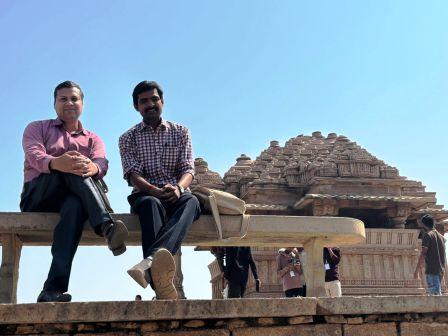


Nice photograph of the two walk leaders.